Written by Mary Ellen O’Toole and Emma Lawrence
In 2022, California’s Governor Newson signed Senate Bill 54 (SB 54) into law. Also known as the Plastic Pollution Prevention and Packaging Producer Responsibility Act, the law focuses on plastics and packaging with a goal to reduce the amount of plastic packaging supplied into the state of California.
The law establishes the state’s Extended Producer Responsibility (EPR) scheme for companies supplying packaging into California and sets targets for a reduced plastic packaging supply by specific years.
CalRecycle selected the Circular Action Alliance (CAA) to be the state’s Producer Responsibility Organization (PRO), and as part of SB 54, the CAA is required to meet identified targets by certain years. To meet the targets, the CAA is dependent on producers to reduce the amount of plastic they sell into the California market and report that reduction to the CAA.
Target years
The goal of source reduction is to reduce the overall net plastic sold into California, regardless of any sales growth. Each year, producers report their supply from the previous year.
There are three identified target years: 2027 (2026 supply), 2030 (2029 supply), and 2032 (2031 supply).
| Targets | 2027 | 2030 | 2032 |
| Reduction by weight and component vs. 2023 | 10% | 20% | 25% |
| Reuse, Refill & Elimination (removal of a plastic component/replacement with nothing) vs 2023 | 2% | 4% | 10% |
Measuring Your Source Reduction
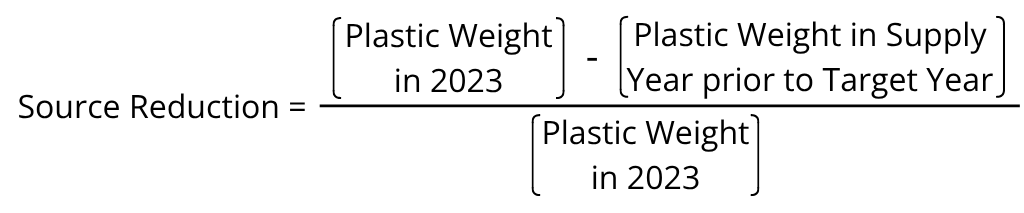
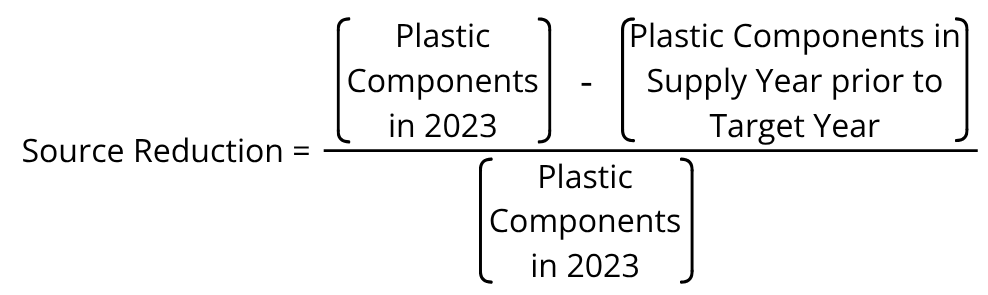
In order to calculate your actual source reduction, the CAA has provided equations for both your total plastic weight and total plastic components.
For plastic weight, source reduction is calculated as your total plastic weight in the baseline year, or 2023, minus your total plastic weight in the supply year prior to the target year, divided by your total plastic weight in 2023. For example, if you’re calculating for target year 2032, you would subtract your total plastic weight for 2031 from your 2023 baseline, then divide by your 2023 baseline. The same logic applies to the calculation for your total plastic components.
Source Reduction by Total Weight
Source Reduction by Total Components
Allocation
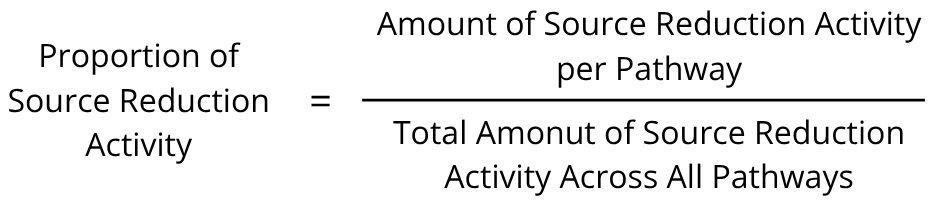
Because your calculated source reduction may not accurately reflect all of the source reduction efforts you have made, the CAA has also created a measurement of source reduction activity, which categorizes the efforts taken and allocates the calculated source reduction to 3 different pathways. The equation to calculate this allocation, as well as the proportion of source reduction activity, are as follows:
Allocated Net Source Reduction

Proportion of Source Reduction Activity
Pathways and Equations to Source Reduction
There are 5 pathways to source reduction, with 3 equations used to calculate your source reduction activity.
Reuse/Refill
This pathway involves transitioning from single-use to reusable or refillable formats that meet the definitions in California PRC section 42041(af). All formats in this pathway must be designed and marketed as reusable/refillable, designed for multiple uses (durable), used multiple times, and managed with suitable infrastructure.
Elimination
This pathway involves the complete removal of a plastic component, without replacing it with any plastic or non-plastic material. If this removal occurs as a part of a design change, such as the removal of a label, Equation A should be used to calculate the source reduction activity. If the elimination is accomplished as part of a decline in sales, then Equation B should be used. Elimination can also be achieved through the implementation of a Bring-Your-Own-Container (BYOC) refill system, in which case Equation C should be used.
Switching to Alternative, Non-Plastic Materials
For this source reduction pathway, producers must switch from a covered material category (CMC) plastic to a CMC non-plastic. Alternative materials that are not considered as recyclable or compostable on the CMC list will not count toward this pathway.
Right-sizing, Concentrating, Lightweighting, and Shifting to Bulk Packaging
This pathway acts as a catch-all for any other packaging changes that result in a reduction of plastic. It includes right-sizing, concentration, lightweighting, and bulk formatting. Right-sizing involves reducing material by eliminating unnecessary space in a packaging format. Concentration is reformulating a product to reduce the amount of packaging needed by requiring smaller quantities of product to achieve the same purpose as the original, larger quantities. Lightweighting is reducing packaging weight, such as by using a thinner material. However, it should be noted that, in order to count as a source reduction activity, the lightweighting cannot make the covered material non-recyclable or compostable, or less likely to be recycled or composted. Bulk formatting is shifting to a packaging format that requires fewer smaller packaging units by packing a large amount of product in a large packaging unit.
PCR Content as Alternative Compliance
The final source reduction pathway is using post-consumer recycled (PCR) content as a form of alternative compliance to meeting rightsizing targets. This pathway allows for more plastic to be supplied into California than the targets permit, provided that the PCR content is third-party validated. The CAA is allowed to claim up to 8% of the PCR supplied into California as alternative compliance and the CAA is expected to release more guidance for producers reporting PCR content.
Equation A: Design Changes
This equation should be used for design changes, such as lightweighting, elimination of a plastic component, shifting to a concentrated formula, bulk formatting, or changing to alternative materials.
Equation A

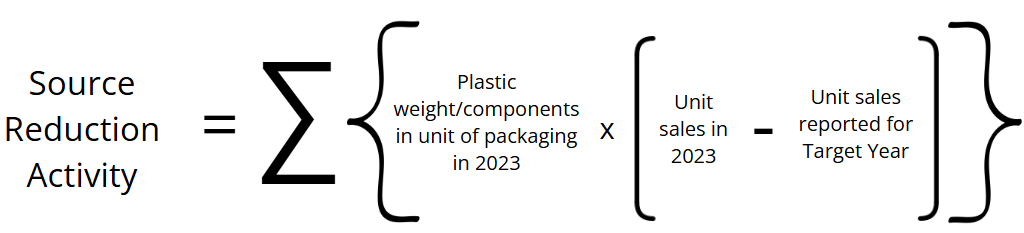
Equation B: Sales changes
This equation should be used for sales-enabled changes, such as elimination by sales reduction, such as by reducing marketing for a SKU, or the complete elimination of a SKU from the market.
Equation B
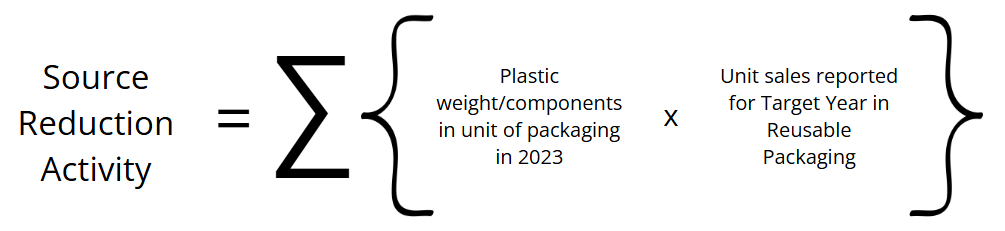
Equation C: Reuse/Refill and BYOC
This equation should be used for shifts to reusable and refillable formats, including shifting to producer-managed systems and consumer-owned, or BYOC systems. It is important to note that for California Source Reduction, BYOC is considered as part of the elimination pathway, but will utilize equation C to calculate the source reduction activity.
Equation C