Plastic Pollution
According to the United Nations Environment Programme, 19 to 23 million tonnes of plastic waste are leaked into aquatic ecosystems annually. This is the equivalent of 2,000 garbage trucks full of plastic being dumped into the world’s oceans, rivers, and lakes every day. Plastic pollution alters natural habitats and results in environmental, social, economic, and health burdens throughout the world.
Historically, life cycle assessments were unable to quantify the environmental impacts of plastic pollution, resulting in a significant gap in the LCA field’s understanding. However, recent methodologies developed by the Plastic Footprint Network (PFN) and Marine Impacts in LCA (MarILCA) have begun closing this gap.
Plastic Footprint Network
The Plastic Footprint Network (PFN) was established with the goal of creating a harmonized and science-based standard for assessing, measuring, and mitigating global plastic pollution. The network builds upon the Plastic Leak Project (PLP), a pioneering methodology developed by Earth Action and Quantis, which introduced a systematic approach to identifying and quantifying plastic leakage.
PFN expands on the PLP through the integration of new scientific data, impact assessment models, and guidance for consistent reporting. Through the creation of several technical modules, PFN provides a standardized foundation for incorporating plastic pollution into specific product categories as well as into life cycle assessment (LCA) studies through the work of MarILCA. One of the key tools developed under this framework is the Mismanaged Waste Index (MWI) for packaging, which quantifies the likelihood of plastic leakage based on waste management practices across countries.
Mismanaged Waste and Plastic Leakage
Mismanaged waste refers to any waste that is not properly disposed of, including waste that is uncollected, littered, or improperly disposed (Figure 1). Following the PLP methodology, mismanaged waste can be estimated using packaging data along with the Mismanaged Waste Index (MWI) from PLASTEAX, a database that provides global leakage and waste management metrics.
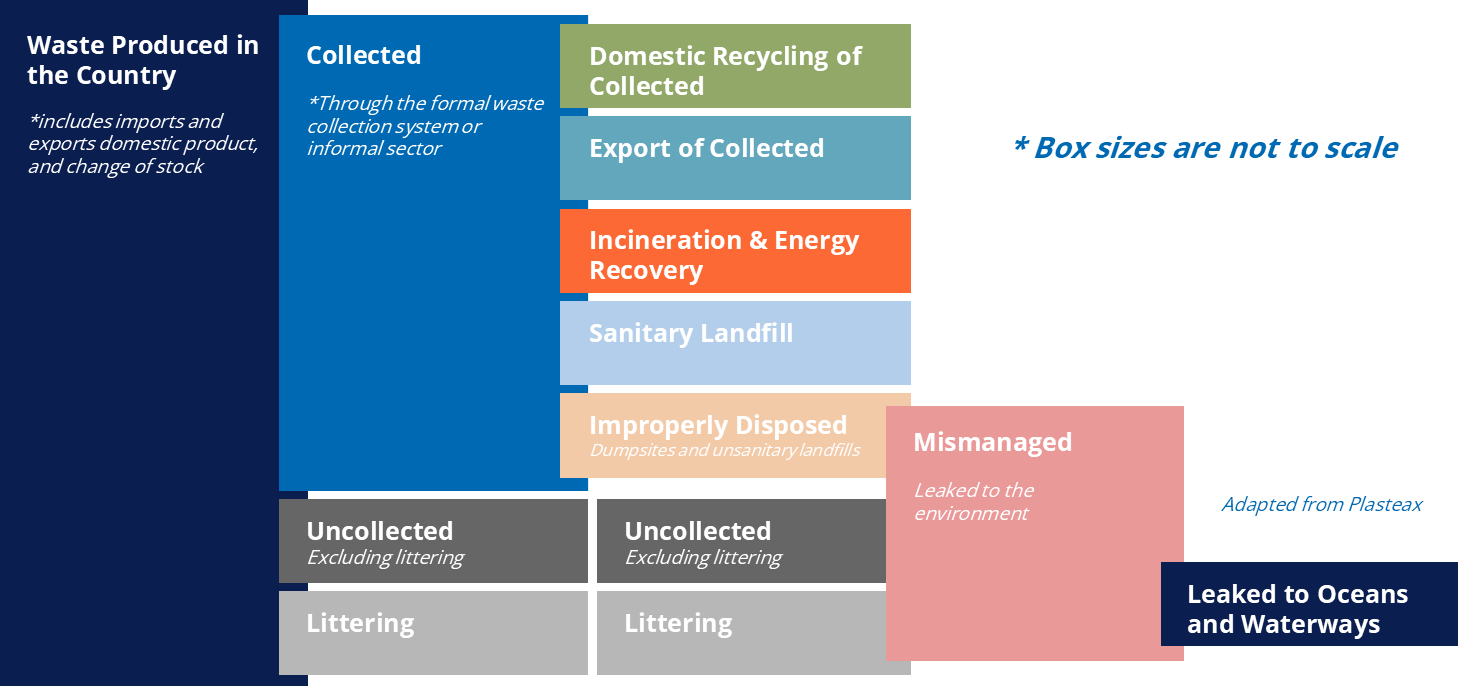
Once mismanaged waste is estimated, it can be further analyzed to estimate the plastic leakage into aquatic and terrestrial environments. Based on the specific characteristics of the packaging, a release rate can be applied to determine the proportion of mismanaged waste that is either released to the ocean and freshwater, released to terrestrial environments, or recollected into the waste stream. Currently, there is limited research on plastic leakage to terrestrial environments, with most research being focused on plastics in marine systems.
Marine Impacts in LCA (MarILCA)
After estimating mismanaged waste and the resulting plastic leakage using the PFN framework, the results can be translated into environmental impacts. The MarILCA team developed characterization factors that estimate the effect of plastic leakage on biota and integrate the results into a life cycle assessment model. The characterization factors were developed for 13 different polymers (Acrylic, EPS, HDPE, LDPE, Nylon, PET, PHA, PLA, PP, PS, PU, PVC, and TRWP), three microplastic shapes (microbeads/unspecified, cylinder/microfiber, microplastic film fragments), and five sizes (1, 10, 100, 1000, 5000 µm). Ongoing research continues to expand on these characterization factors to include additional materials, such as bioplastics.
Through the recent methodological improvements from the PFN and MarILCA, plastic leakage can now be systematically quantified and integrated into life cycle assessments, closing the gap in the evaluation of plastic pollution impacts.
Staying Ahead of Changing Regulations
With these new methodologies allowing for plastic leakage to be estimated, the expectation for it to be included in LCA reports will likely continue to increase. For example, Oregon’s EPR eco-modulation now requires MWI and MarILCA to be considered in the LCA calculations. Future standards and regulations are likely to follow suit to ensure that LCAs provide the most comprehensive assessment possible.
For more information about the MWI feature in EcoImpact-COMPASS or to explore how Trayak’s EcoImpact Sustainability Platform can help your business, contact your Trayak representative or reach us at:
+1(513)445-3264