
There are many important factors to consider when making a comparison between rigid and flexible packaging formats. While life cycle assessment (LCA) is a valuable tool for evaluating trade-offs across environmental impact indicators, a package’s environmental footprint is only one part of a holistic decision-making process.
Given the evolving landscape of global packaging regulations, oftentimes decision makers must also consider additional attributes. For example, package recyclability plays a significant role in compliance with regulations laid out in EPR programs such as California’s SB 54. As a result, evaluating packaging formats solely on their performance across standard environmental indicators may not provide a complete picture. Considering regulatory requirements and other packaging attributes alongside LCA results can help organizations make more informed and holistic decisions that can help them achieve their current goals while also preparing for future requirements.
Flexible vs. Rigid: What’s The Difference?
This example compares a rigid HDPE canister with a flexible multi-material bag. The HDPE canister includes a closure, induction seal, and paper label as part of the primary packaging. The flexible bag includes a paper label and a zipper closure.
In addition to evaluating the primary packaging, this analysis also considers the secondary and tertiary packaging to provide a more complete view of the environmental impacts. When conducting LCA comparisons, it is recommended to include secondary and tertiary packaging whenever they differ between options and data is available. Changes to primary packaging often affect packaging requirements at other levels, which can shift impacts throughout the supply chain.
Environmental Impact Comparison Using EcoImpact-COMPASS
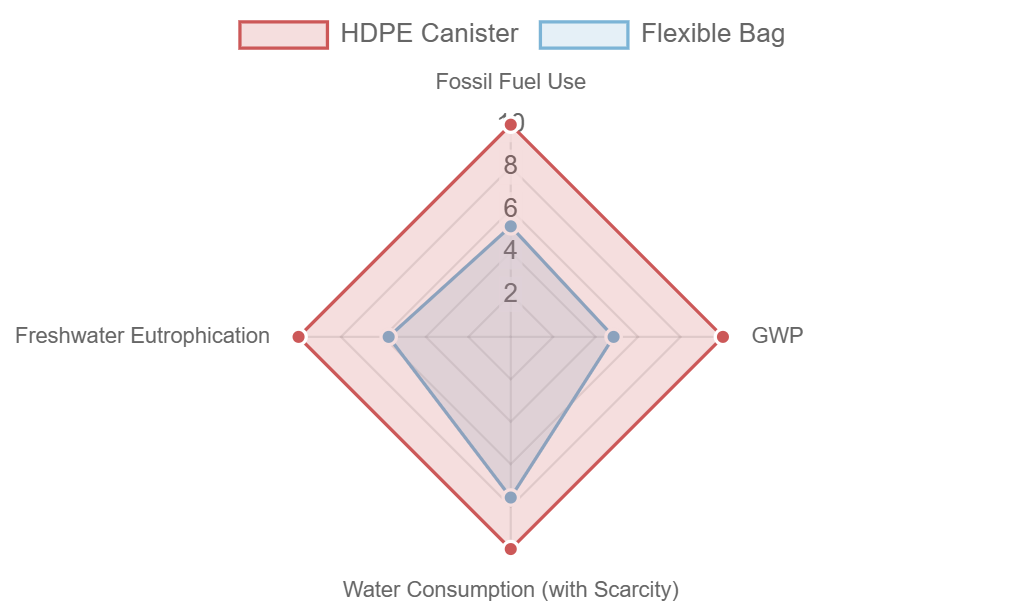
To compare the environmental impacts of the two packaging formats, EcoImpact-COMPASS was used to conduct a life cycle assessment (LCA). This assessment measured the environmental footprint of each packaging format throughout its life cycle, providing comprehensive data that can be used for sustainability comparisons. The analysis focused on four indicators: Fossil Fuel Use, Global Warming Potential (GWP), Freshwater Eutrophication, and Water Consumption.
As shown in the spider chart, the flexible bag has lower impacts for all 4 indicators when compared to the HDPE canister. This is primarily due to the weight savings and improved palletization of the flexible bag, since it is lighter and more units can fit within the secondary and tertiary packaging levels. However, the environmental indicators don’t reveal every single trade-off. Companies that are trying to make holistic decisions about which packaging format best meets their needs should consider additional attributes as well.
Recyclability vs. Overall Environmental Impact
The ability of an individual package to be recycled is becoming an increasingly important attribute for consideration, and it can be added alongside other indicators in the spider chart analysis in EcoImpact-COMPASS.
As seen in the updated chart below, although the flexible bag performs better across all four environmental indicators, it is considered less recyclable than the rigid HDPE canister because it is a composite flexible material. Both of the additional attributes shown in the chart represent recyclability metrics.
The first additional attribute, end of life (EOL) recycling potential, shows the total percentage of packaging mass that is recyclable, rolled up across all components within each packaging system. The second attribute, primary package recyclability score (0–5), rates the ability of the primary package to be recycled based on industry-average, regional recycling rates that are auto-calculated in EcoImpact-COMPASS. Using this methodology, composite materials such as the flexible bag receive a recyclability score of 0. The HDPE canister receives a score of 4 because its industry-average recycling rate falls between 20–29%.

A Holistic View of Sustainable Packaging
Recyclability is just one tradeoff that is important to consider when designing packaging formats and making decisions. It is important to weigh all factors that will impact future compliance with regulatory requirements wherever the packaging is being sold. Although the environmental indicators may show one aspect of a comparison, it is crucial to consider a more holistic view.
As demonstrated in this comparison, a package may perform better across every environmental indicator, yet present other challenges related to recyclability and regulatory compliance. Understanding these trade-offs is essential for making informed packaging decisions.
Trayak’s EcoImpact platform allows you to easily visualize all of the attributes and trade-offs your company may be considering. In addition to the environmental indicators and recyclability, you can also include other attributes such as damage rate, EPR fees, product shelf life, cost, and more. While every company has its own unique goals, using a platform like EcoImpact-COMPASS will help you make better and more informed choices.