

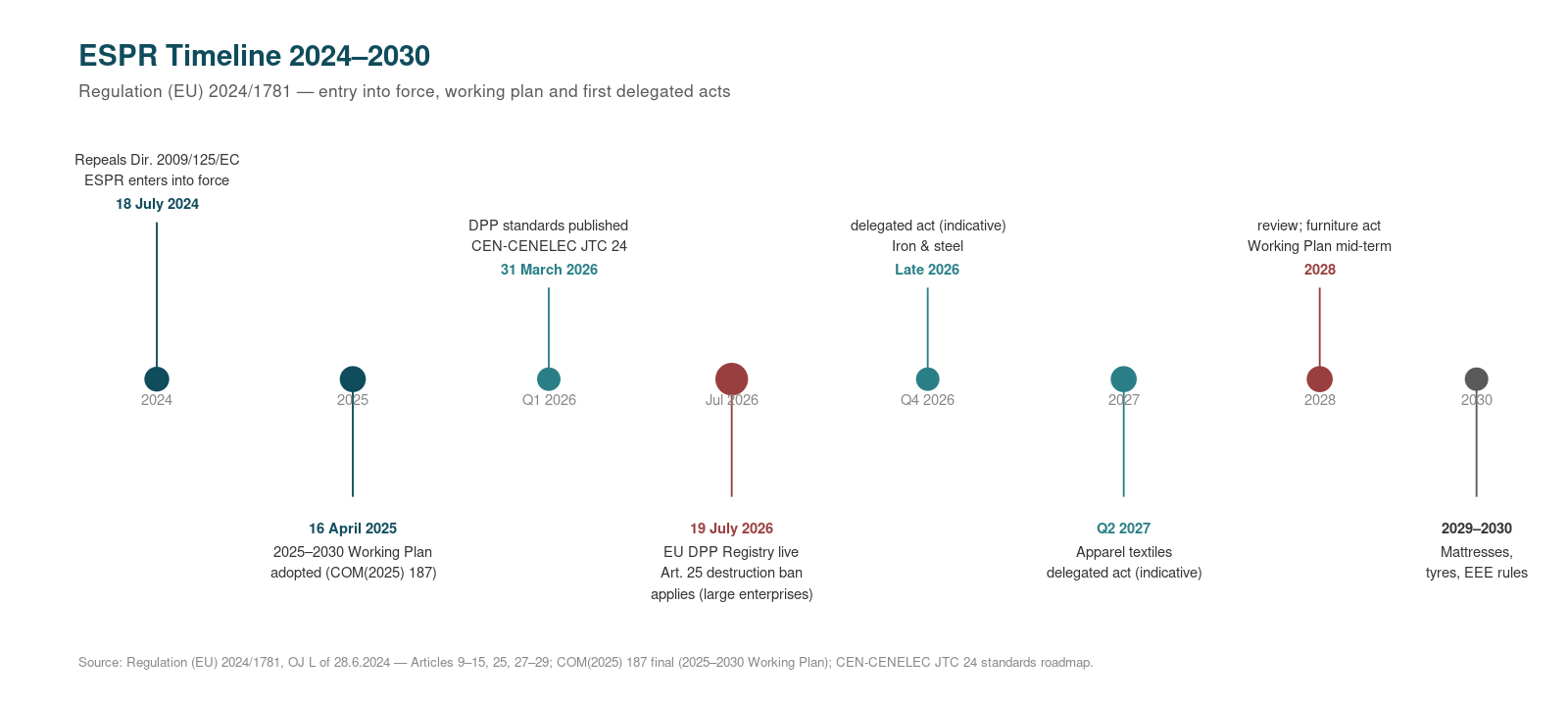
ESPR (Regulation (EU) 2024/1781) is in force since 18 July 2024. The framework regulation behind the Digital Product Passport. What it covers, who is affected, and what every operator now needs to put in place.
What is ESPR?
ESPR is Regulation (EU) 2024/1781, the EU framework for ecodesign. It replaces the old Ecodesign Directive 2009/125/EC, which for fifteen years covered only energy-related products such as fridges, lighting, and motors. ESPR drops that limitation. The regulation extends ecodesign logic to virtually every physical product placed on the EU market, with the usual exclusions for food, feed, medicinal products and living organisms.
ESPR is a framework regulation. The base text does not list product-specific requirements. The Commission adds them, product category by product category, through delegated acts. Every covered product carries a Digital Product Passport.
What does ESPR change?
ESPR sets a horizontal product framework across the EU. It covers:
-
- Ecodesign Parameters: durability, reparability, recyclability, recycled content, energy efficiency, substances of concern, carbon and environmental footprint.
-
- Digital Product Passport: a structured machine-readable dataset attached to every product, accessible via a data carrier (QR, RFID, NFC).
-
- EU DPP Registry: operational from 19 July 2026 under Article 13.
-
- Destruction-of-unsold-goods ban: Article 25 applies to apparel and footwear from 19 July 2026 for large enterprises.
-
- Public Procurement: mandatory minimum eco-conscious procurement criteria under Article 65.
-
- Operator Obligations: CE Marking, EU Declaration of Conformity, technical documentation retained for ten years.
Each product category is bound by its own delegated act. The first wave starts with iron, steel, and apparel textiles, the second wave likely furniture, mattresses, tyres and electronics.
The Digital Product Passport
Every covered product on the EU market needs a DPP — a structured data object accessed by QR, RFID or NFC. Confidential by tier, open to consumers, recyclers, repairers and market-surveillance authorities each at the right level
The 2025–2030 Working Plan
The Commission adopted the ESPR Working Plan on 16 April 2025 (COM(2025) 187 final). It is where the framework turns into a concrete pipeline of delegated acts. The dates below are indicative until each act is adopted — but they are the working baseline.
2026
Iron and Steel
First intermediate-product delegated act. Embedded carbon and recycled content audit-grade.
2027
Apparel Textiles
Footwear held back for a preparatory study completing in 2027.
2028
Furniture
Addition of horizontal repairability score across categories.
Chemicals & Footwear
May be added next.
2029
Electronics and ICT
EEE recyclability requirements across the category.
Mattresses
Potential inclusion of Tyres.
What Affected Companies should do
ESPR follows the same New Legislative Framework logic as CE-marked products. Articles 27 to 29 assign obligations by operator role, not by sector. A single legal entity can hold more than one role at the same time.
Find the role your company plays per product, per Member State. If you hold more than one role, the obligations stack.
Manufacturers and Brand owners
The manufacturer designs the product to meet the applicable ecodesign requirements and signs the EU Declaration of Conformity. A brand owner that places a product on the EU market under its own name is the manufacturer, even if a third party physically produces it.
-
- Draw up the technical documentation under Annex IV
-
- Carry out conformity assessment and issue the EU Declaration of Conformity
-
- Affix the CE marking where the delegated act requires it
-
- Populate the Digital Product Passport for each product unit
-
- Retain documentation for 10 years after the last unit is placed on the market
-
- Cooperate with market-surveillance authorities on request
Importers
Importers placing third-country products on the EU market verify that the foreign manufacturer has done the work properly. Watch Article 28: an importer that modifies the product or places it under its own name becomes the manufacturer for ESPR purposes.
-
- Verify the manufacturer’s conformity assessment, technical documentation and DPP
-
- Check CE marking, labels and required translations
-
- Retain documentation for 10 years.
-
- Inform authorities and the manufacturer if a non-compliance is found
Distributors
Distributors act with due care when making products available on the EU market. They are the last line of compliance before a product reaches the customer.
-
- Verify the product carries correct marking and labels
-
- Verify the DPP is accessible via the data carrier
-
- Ensure storage and handling do not compromise compliance
-
- Inform the manufacturer or importer if non-compliance is found
Fulfilment Service Providers, Online Marketplaces, Search Engines
ESPR explicitly covers fulfillment service providers (Article 27), online marketplaces and online search engines (Article 29). They cooperate with surveillance and can be ordered to remove non-compliant listings.
-
- Ensure warehousing, packaging and dispatch do not compromise compliance
-
- Cooperate with market-surveillance authorities
-
- Remove non-compliant listings on order from authorities
The destruction-of-unsold-goods ban
One ESPR provision is already biting in 2026. Article 25 prohibits the destruction of unsold consumer products listed in Annex VII. Annex VII currently lists apparel, clothing accessories and footwear.
-
- Large enterprises: ban applies from 19 July 2026.
-
- Medium enterprises: ban applies from 19 July 2030.
-
- Micro and small enterprises: exempted, for now.
-
- Ten derogations defined in the Commission’s February 2026 delegated act (safety hazards, damage, manufacturing defects, legal non-compliance, and others).
-
- Annual reporting obligation for large enterprises on what was destroyed and why.
The 2028 Working Plan mid-term review is the most likely moment for the scope to extend to other consumer-goods categories. Companies outside textiles should still audit their exposure.
What do you need for ESPR compliance?
1 – A complete Bill of Product for every in-scope SKU
2 – Cradle-to-grave LCA with chain-of-custody evidence
3 – Supplier data for substances, recycled content and material composition
4 – An LCA platform that feeds DPP, PPWR, CBAM and CSRD from one source
Disclaimer
This page reflects the text of Regulation (EU) 2024/1781 as published in the Official Journal on 28 June 2024 and the Commission’s 2025–2030 ESPR and Energy Labelling Working Plan COM(2025) 187 final of 16 April 2025. The delegated-act timing (iron and steel ~2026; apparel textiles ~Q2 2027; furniture ~2028; mattresses ~2029) is explicitly indicative in the Commission’s own language; binding obligations apply when each delegated act is adopted. The CEN-CENELEC JTC 24 horizontal DPP standards are scheduled to publish around 31 March 2026, and may be referenced in subsequent delegated acts. We will update this page as each delegated act and supporting standard arrives.